Is Gratuity Taxable In India?

Yes, gratuity is taxable in India, but significant exemptions apply. Government employees receive a full tax exemption on gratuity received, with no upper limit. For private sector employees, the gratuity exemption under Section 10(10) of the Income Tax Act is capped at Rs 20 lakh. Any amount above this is taxable as salary income. Gratuity eligibility requires a minimum of five years of continuous service, except in cases of death or disability.
You have been a loyal employee for years, and upon your resignation, you received a generous payout package from your employer. Well, think of gratuity as a financial 'thank you' for your years of service. However, according to a survey by Grant Thornton, 99% of respondents felt that their gratuity is insufficient. Nonetheless, receiving gratuity can feel rewarding, but for many people, a question often arises: 'Is gratuity taxable in India?'
Well, for some employees, gratuity can be completely tax-free, while others must pay taxes on it. The rules regarding taxation on gratuity depend on whether you are working in the private sector or are a government employee. If you are planning your retirement and wondering whether taxes will apply to your gratuity, it is essential to understand the details.
In this article, we will break down the different aspects of gratuity, shed light on the gratuity exemption limit, and answer whether gratuity is taxable or not.
Who Is Eligible for Gratuity and What Are the New Rules?
Gratuity eligibility is governed by the Payment of Gratuity Act, 1972, which applies to organizations with 10 or more employees. Once applicable, the Act continues to cover the organization even if the employee count later drops below 10.
You qualify for gratuity when:
- You resign or retire after completing a minimum of five years of continuous service
- You leave due to superannuation
- You die or become permanently disabled (the five-year rule does not apply in these cases)
The new rule most relevant to employees: the tax exemption ceiling for private sector workers was revised to Rs 20 lakh, up from Rs 10 lakh. This change, notified in 2021, significantly increased the tax-free benefit for long-serving employees. The formula remains unchanged:
Gratuity = (15 x Last Drawn Salary x Years of Service) / 26
The last drawn salary includes basic pay and dearness allowance. If service in the final year exceeds six months, it is rounded up to a full year.
How to Calculate Gratuity?
Another question that arises when it comes to gratuity is, ‘How to calculate gratuity?’ Considering that gratuity and its calculation are still the most misunderstood concepts, let's understand how to calculate gratuity:
Formula to calculate gratuity:
- Gratuity = 15 x Last drawn salary x Number of years of service / 26
Here:
- The last drawn salary includes basic pay, along with a dearness allowance.
- The number of years of service will be rounded up if the period exceeds 6 months in the last year.
Let us understand this with an example:
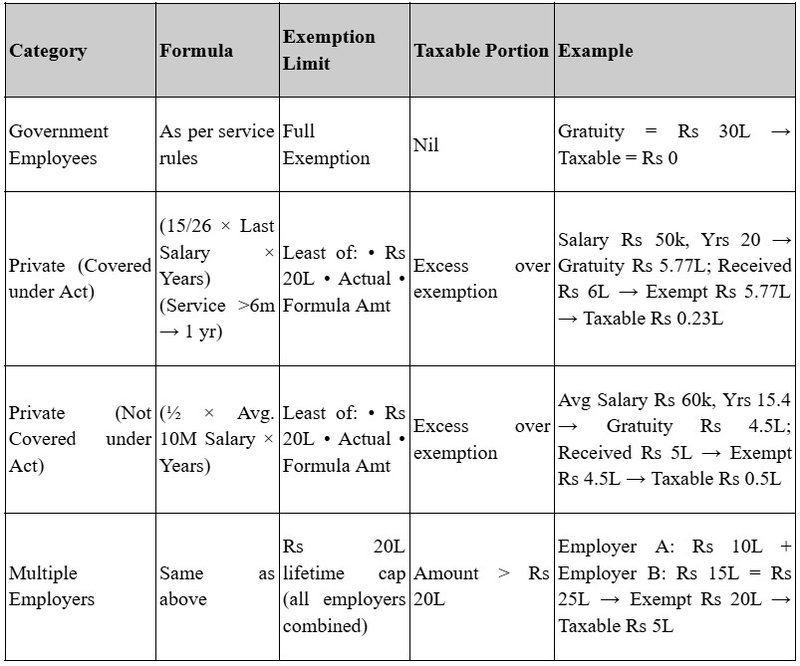
If the last drawn salary is Rs 50,000 and the service is 10 years:
Then the gratuity calculation will be:
- Gratuity = (15 x 50,000 x 10) / 26
- Gratuity = Rs 2,88,462
Is Gratuity Taxable on Resignation?
Yes, gratuity received on resignation is taxable, but the exemption rules still apply. Whether gratuity is taxable on resignation depends on your employment type and the amount received.
For a private sector employee covered under the Payment of Gratuity Act, 1972, the exempt portion is the least of:
- Rs 20 lakh (the current gratuity exemption limit)
- Actual gratuity received
- 15 days' salary for each completed year of service
Any amount above the exempt portion is added to your taxable salary and taxed at your applicable slab rate. So if you receive Rs 22 lakh as gratuity on resignation after 20 years of service, Rs 20 lakh is exempt, and Rs 2 lakh is taxable.
Is Gratuity Taxable for Government Employees?
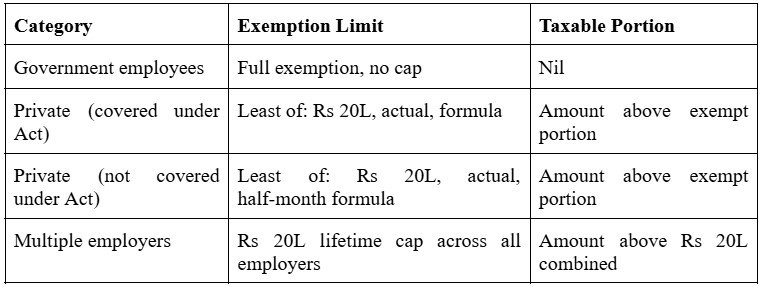
No. Gratuity received by the central government, state government, local authority, or defense employees is fully exempt from income tax under Section 10(10)(i) of the Income Tax Act. There is no upper cap on the amount. The entire sum, regardless of size, is tax-free.
This is the most straightforward category. A government employee who receives Rs 40 lakh as gratuity pays zero tax on it.
Is Gratuity Taxable in India for Private Companies?
Yes, but only above the exemption threshold. The gratuity rule for private employees depends on whether the company is covered by the Payment of Gratuity Act.
Covered under the Act (10 or more employees): The exemption is the least of Rs 20 lakh, the actual gratuity received, or the formula-calculated amount. Amount exceeding the exempt portion is taxable as salary.
Not covered under the Act: The exemption is the least of:
- Rs 20 lakh
- Actual gratuity received
- Half a month's average salary (based on the last 10 months) multiplied by completed years of service
This means whether gratuity is taxable or not for private company employees comes down to one question: Does the amount exceed the applicable exemption? If it does not, the full amount is tax-free.
Gratuity Calculation and Tax Summary
Is Interest on Gratuity Taxable or Not?
Yes. While the principal gratuity amount may be fully exempt, interest on gratuity is taxable. If your employer delays payment beyond 30 days (the statutory deadline under the Payment of Gratuity Act and pays interest on the delayed amount, that interest is fully taxable under the head "Income from Other Sources." The exemption under Section 10(10) does not extend to interest.
Gratuity Calculation & Tax Implications
Here are the different scenarios and the subsequent gratuity calculations and tax implications:
Key Points on Gratuity Exemption
- The Rs 20 lakh gratuity exemption limit applies per lifetime, not per employer. If you have worked for multiple companies and received a combined gratuity of Rs 25 lakh, only Rs 20 lakh is exempt.
- Gratuity received on resignation is taxable in the same way as gratuity received on retirement. The circumstance of leaving does not change the exemption rules.
- Even fully exempt gratuity must be reported under "Exempt Income" in your Income Tax Return.
- The gratuity exemption under Section 10(10) is available under both the old and new tax regimes.
- TDS is deducted by employers only on the taxable portion of gratuity, not on the exempt amount.
How to Check Gratuity Amount?
Knowing how much gratuity you will receive will help you plan your finances better. It becomes even more necessary when planning for retirement or considering a job change. There are several ways to check your gratuity amount, and they are explained as follows:
- Use the formula to calculate gratuity as per the Payment of Gratuity Act 1972.
- When you resign or retire, your HR department will automatically calculate the gratuity amount. You can also request that the HR department provide you with the details.
- You can also use online gratuity calculators on different platforms. These platforms will help you to know the gratuity amount as well as the tax-exempt portion.
- Some organisations may mention gratuity breakdown on salary statements.
Knowing if gratuity is taxable can help create a personalised financial plan.
Plan Your Gratuity Smartly With FinAtoZ
Gratuity is one component of your overall retirement corpus. Whether you are planning a job change, approaching retirement, or evaluating your long-term financial position, understanding how gratuity fits into your tax picture matters.
FinAtoZ (RightFocus Investments Pvt. Ltd.) is a SEBI-registered Investment Adviser (INA200006628) that works with salaried professionals and retirees on tax-efficient financial planning. Our Certified Financial Planners help you build a retirement strategy that accounts for gratuity, EPF, and other post-employment income.
You can also read our related guides: Financial Planning for Senior Citizens and Retirees and How to Save Tax Legally in India.
Book a free introductory call with a FinAtoZ Certified Financial Planner
This article is for informational purposes only and does not constitute tax or legal advice. Consult a qualified tax advisor for guidance specific to your situation.
Conclusion
Gratuity is a financial reward for your loyalty and long-term service. The answer to the question, 'Is gratuity taxable in India?' is not a straightforward yes or no; it involves several layers. For a government employee in any sector, the entire gratuity amount is tax-free; however, for private sector employees, the gratuity exemption limit is Rs 20 lakhs (revised). Knowing the gratuity exemption limits will help you plan your finances more effectively. Gratuity is a hard-earned benefit, and with proper knowledge, you can make the most of it without losing it to taxes.
Frequently Asked Questions
Is gratuity taxable on resignation?
Yes, but the exemption still applies. For private-sector employees covered under the Payment of Gratuity Act, the exempt amount is the least of Rs 20 lakh, the actual gratuity received, or the formula amount. Any excess is taxable as salary income.
Is gratuity taxable for government employees?
No. Gratuity received by government employees is fully exempt under Section 10(10)(i) of the Income Tax Act, with no upper limit on the amount.
Is interest on gratuity taxable or not?
Yes. Interest paid on delayed gratuity is fully taxable under "Income from Other Sources." The Section 10(10) exemption covers only the gratuity principal, not the interest component.
Is gratuity taxable for private companies in India?
Yes, above the exemption limit. The gratuity exemption for private sector employees is capped at Rs 20 lakh. Amounts above this are taxable at the applicable income slab rate.
Do I need to complete 5 years of service to receive gratuity?
Yes. A minimum of 5 years of continuous service is required. However, in the event of death or disability, gratuity is payable even if the 5 years are not completed.
Is there TDS on gratuity?
Yes. Employers deduct TDS on the portion of gratuity that is taxable (amount exceeding the exemption).
Do I have to declare gratuity in ITR if it is exempt?
Yes. Even if fully exempt, gratuity must be reported under "Exempt Income" in your income tax return.
Get Expert Financial Advice
Book an introductory call with our Certified Financial Planner to explore how we can help you achieve your financial goals.
Book Your Appointment

