

If you live in Dubai and earn income in India, from rent, capital gains, NRO interest, or investments, you are required to file an income tax return in India.
Who Exactly Is an NRI for Indian Tax Purposes?
You are an NRI for a given financial year if you spent fewer than 182 days in India during that year (April 1 to March 31).
There is a secondary rule worth knowing. If you spent 365 or more days in India across the previous four financial years and 120 or more days in the current year, India may still treat you as a tax resident. This catches Dubai-based professionals who visit India frequently for family or business.
Your residential status governs everything, including which income gets taxed, which ITR form you use, and what exemptions apply. Confirm your status before you decide whether to file an income tax return in India as an NRI.
Is Dubai Salary Taxable in India for NRIs?
No. As of 2026, if you work in the UAE and receive a salary, the UAE government does not tax your income. And because your salary is earned and received abroad, India does not tax it either, as long as you qualify as an NRI under Section 6 of the Income Tax Act.
This is one of the clearest advantages of the Dubai NRI situation. The UAE has no income tax, and the India-UAE DTAA makes the cross-border position clean.
However, "simple" does not mean "nothing to file." Most Dubai NRIs have at least one India-linked income source that creates a filing obligation.
What Indian Income Is Taxable for a Dubai NRI?
India taxes NRIs on income earned or accrued in India. The following are the most common types:
Rental income from property held in India is taxable. The tenant typically deducts TDS, but you may owe additional tax or qualify for a refund depending on your actual liability.
NRO account interest is taxable at 30% TDS. NRE and FCNR account interest is fully exempt as long as you maintain NRI status.
Capital gains need to be separated by asset type, because the India-UAE DTAA treats them differently.
Mutual fund gains are effectively tax-free for Dubai NRIs. Under Article 13 of the India-UAE DTAA, gains on Indian mutual fund units are taxable only in your country of residence. The UAE levies no capital gains tax, so the effective rate is zero. The fund house still deducts TDS at redemption, so you file an ITR with your TRC and Form 10F to reclaim it. This benefit covers mutual fund units only, not direct shares.
Share gains are taxable in India. Short-term gains on listed shares sold within 12 months are taxed at 20%. Long-term gains above ₹1.25 lakh are taxed at 12.5% without indexation.
Property gains are taxable in India, and the DTAA does not change this. For property sold on or after July 23, 2024, long-term gains (held over 24 months) are taxed at a flat 12.5% without indexation. The 20%-with-indexation option is not available to NRIs. It applies only to resident individuals and HUFs. Short-term gains are taxed at your applicable slab rate.
Business income from a company controlled or managed from India is taxable even if you live abroad.
When Is an NRI Required to File an Income Tax Return in India?
Filing is mandatory when your total Indian income exceeds the basic exemption limit. Under the old regime, the limit is ₹2.5 lakh. Under the new regime for FY 2025–26, it is ₹4 lakh. The due date for FY 2025–26 is July 31, 2026.
There is an important exception. If an NRI's only Indian income is from special investments in foreign currency and TDS has already been deducted on that income, filing under Section 115G of the Income Tax Act is not mandatory.
Even when filing is not mandatory, it is usually worth doing. Filing lets you claim refunds on excess TDS deducted from NRO interest or rental income. It also creates a clean compliance record, which matters when repatriating funds or selling property later.
Important: Budget 2026 introduced a one-time 6-month scheme for the disclosure of foreign assets. If you accidentally missed declaring something in the past, an old bank account, company shares from a previous job, this scheme gives you a legal way to correct the record without prosecution. The window is limited.
Which ITR Form Should a Dubai NRI Use?
NRIs cannot use ITR-1 or ITR-4. The correct form depends on your income type.
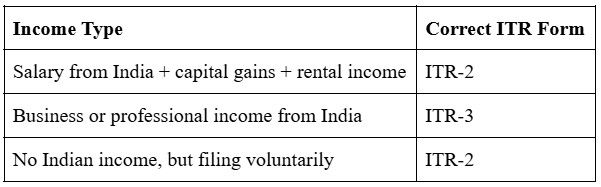
Income type chart
NRIs filing ITR-2 must now disclose assets held in India exceeding ₹1 crore, including bank deposits, property, mutual fund investments, and shares. Liabilities exceeding ₹50 lakh associated with these assets must also be reported.
How Does the India-UAE DTAA Protect You from Double Taxation?
The Double Taxation Avoidance Agreement between India and the UAE ensures that the same income is not taxed twice. Since the UAE levies no personal income tax, the practical benefit for most Dubai NRIs is reduced TDS rates on dividends, interest, and royalties, not foreign tax credits.
To claim DTAA benefits, you need to submit a Tax Residency Certificate (TRC) from the UAE Federal Tax Authority along with Form 10F to the Indian payer. Without these documents, the payer deducts TDS at the standard higher rate.
As of 2025, the UAE has signed over 140 DTAAs with countries worldwide, including India, the UK, China, and Singapore.
The Dubai NRI's Hidden Tax Risk: The Day-Count Trap
Most NRIs know the 182-day rule. Fewer track the secondary threshold, and it is here that avoidable tax bills are created.
If you visit India regularly for family, business, or medical reasons and accumulate 120 or more days in the current financial year while having spent 365 or more days in India over the last four years, India may classify you as a resident. Your worldwide income, including your Dubai salary, then becomes taxable in India.
Get Expert Financial Advice
Book an introductory call with our Certified Financial Planner to explore how we can help you achieve your financial goals.
This is the pattern FinAtoZ advisors see most often among Dubai-based NRI clients: a gradual erosion of NRI status through untracked visits, with no awareness until a large tax bill arrives.
The fix is straightforward. Track your dates of stay in India using passport stamps. Keep the count below 120 days if you are close to the four-year threshold. One extra week in India can cross the line.
Step-by-Step: How to File an Income Tax Return in India as an NRI
Step 1: Confirm your residential status. Calculate your India days for the full financial year. Use your passport as the primary record.
Step 2: Gather your income documents. Collect Form 26AS (shows all TDS deducted), Form 16A from banks and tenants, capital gains statements from mutual fund houses or brokers, and rental agreements.
Step 3: Obtain your TRC if claiming DTAA. Request a Tax Residency Certificate from the UAE Federal Tax Authority. Submit Form 10F to any Indian payer who needs to reduce TDS.
Step 4: Choose the correct ITR form. For most Dubai NRIs who need to file an income tax return in India, the ITR-2 is used.
Step 5: File online at the Income Tax e-filing portal. The portal is at incometax.gov.in. Use your PAN to log in. NRIs use the same portal as residents.
Step 6: Verify your return. E-verify using your Indian mobile number linked to Aadhaar, or send a signed physical acknowledgement (ITR-V) to CPC Bengaluru.
Step 7: Track your refund. If the TDS deducted exceeds your actual tax liability, the refund is credited to your PAN-linked Indian bank account within two business days of ITR processing, per FinAtoZ's advisory FAQ.
Key Budget 2026 Changes That Affect Dubai NRIs
India's Union Budget 2026 includes several measures that directly affect the income tax returns of NRI filers from the UAE.
Three changes are most relevant for Dubai NRIs filing this year:
Property sale TDS: For UAE-based NRIs selling property in India, TDS will now be managed by the resident buyer, removing the earlier requirement linked to obtaining a TAN. This simplifies one of the most burdensome administrative aspects of NRI property sales.
Investment limits raised: Under the Portfolio Investment Scheme, the investment cap for an individual Person Resident Outside India has been raised from 5% to 10%, while the overall limit for all such investors in a single listed company has increased from 10% to 24%.
Foreign asset disclosure: A one-time disclosure scheme for assets below ₹20 lakh allows correction of past non-disclosure of small assets without prosecution.
How FinAtoZ Helps Dubai NRIs with Indian Tax Compliance
FinAtoZ is a SEBI Registered Investment Adviser (INA200006628) and a team of Certified Financial Planners based in Bengaluru. The firm works with NRI clients across the UAE to manage Indian investment portfolios and coordinate tax-efficient financial planning.
One client case illustrates a common problem. Sabyasachi Mukhopadhyay, a manager at Ericsson India Global Services, found that a child education policy recommended by his bank delivered neither adequate maturity value nor appropriate returns. FinAtoZ advised him to surrender the policy, redirect the funds into recommended mutual funds, and increase his monthly savings toward the goal. His child's education plan is now on track. Read the full client testimonial on FinAtoZ's website.
For NRI-specific advisory, FinAtoZ offers a comprehensive financial planning package starting at ₹24,000, followed by ongoing advisory at 1.2% of AUM annually. This covers goal-based portfolio management, tax harvesting, and coordination across Indian asset classes. To understand how to evaluate a regulated advisor, read what to look for when choosing a SEBI-registered financial advisor.
Frequently Asked Questions
Do I need to file an income tax return in India if I live in Dubai and have no income in India?
No. If you have no Indian income and your residential status is NRI, you are not required to file. However, if TDS has been deducted from any Indian source, even on a dormant NRO account, you can file a refund claim.
Is my Dubai salary taxable in India?
No, as long as you qualify as an NRI. The salary is earned and received outside India. It is not taxable in India, regardless of whether you remit it to an Indian account.
What is the filing deadline for NRIs for FY 2025–26?
July 31, 2026. A belated return can be filed until December 31, 2026, with applicable late-filing fees under Section 234F.
Can I file an income tax return for NRI status online?
Yes. The Income Tax Department's e-filing portal at incometax.gov.in handles NRI returns. NRIs use ITR-2 in most cases and e-verify using their Indian mobile number or by mailing a signed ITR-V.
Do I need a CA to file an income tax return in India as an NRI?
Not legally. But if you have capital gains, rental income, DTAA claims, or Indian investments, errors in form selection or TDS claims are common. A qualified SEBI-registered advisor reduces the risk of notices from the Income Tax Department.
Get Expert Financial Advice
Book an introductory call with our Certified Financial Planner to explore how we can help you achieve your financial goals.
About the author
Ashish Vryse